Introduction: When Coding Feels Like a Conversation
There’s a new trend sweeping through the developer community called vibe coding — and it’s changing the way people build applications.
Instead of wrestling with lines of code in isolation, you co-create with an LLM (Large Language Model) like ChatGPT, Claude, or Gemini, iterating in real time based on the “vibe” of your project.
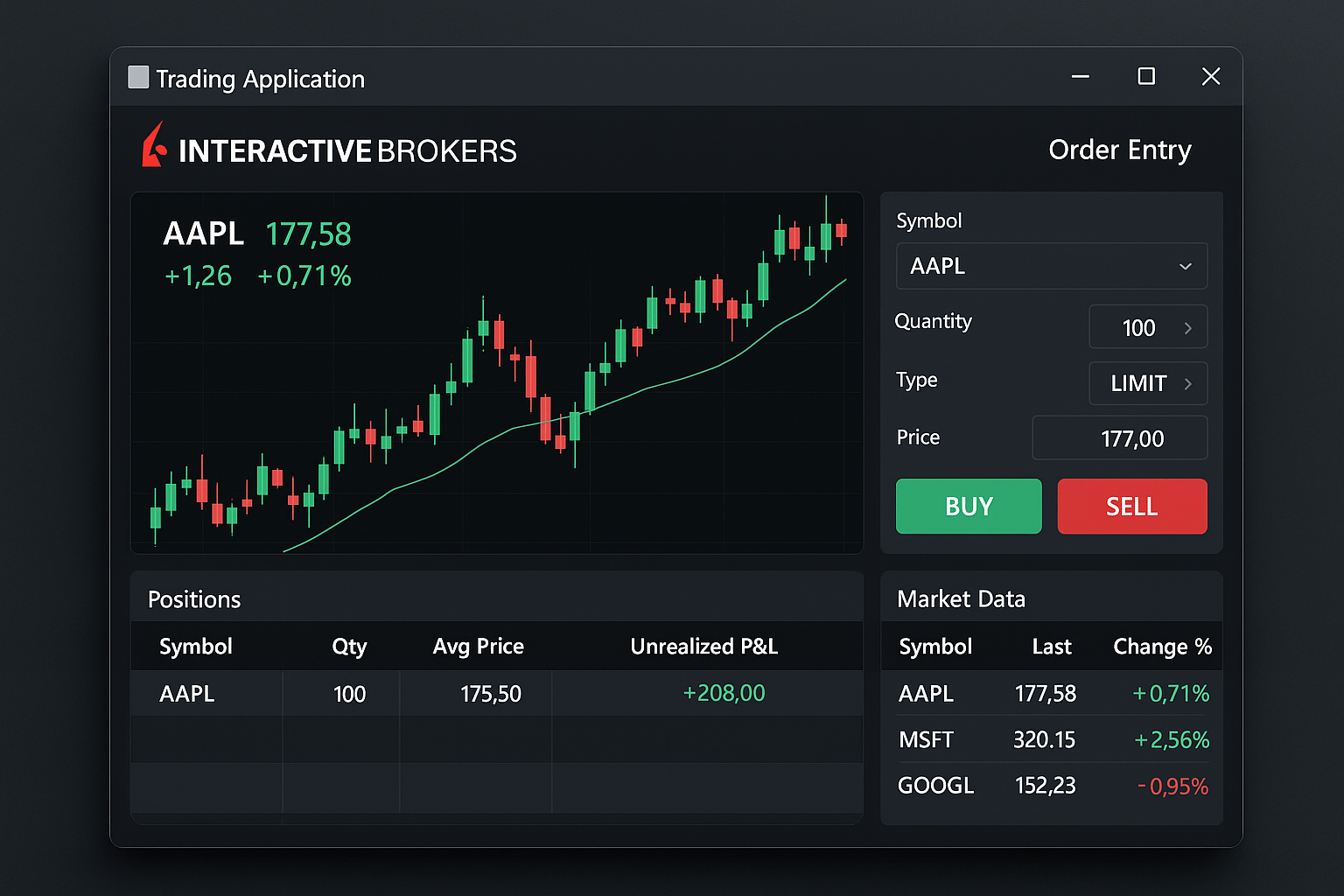
Recently, I took this approach to a whole new level by vibe coding a trading application using the Interactive Brokers API (IBAPI). The result? A functional Windows-based trading app, complete with live market data, order management, and integration with my broker — all built faster than I thought possible.
In this post, I’ll walk you through:
- What vibe coding really means
- How LLMs act as your development partner
- Why it works especially well for trading applications
- A behind-the-scenes look at my IBAPI project
- The pros, cons, and best practices if you want to try it yourself
What Is Vibe Coding?
At its core, vibe coding is an iterative, conversational style of programming where you let an AI model guide, adapt, and inspire the development process. Instead of writing an entire spec up front, you:
- Describe the idea — not in formal requirements, but in your own words.
- Ask the AI to generate code snippets or entire modules.
- Test, refine, and adjust in small cycles.
- Lean on the AI for problem-solving, debugging, and even brainstorming UX ideas.
It’s like pair programming, but your partner is a Large Language Model trained on millions of coding examples, documentation, and best practices.
Where traditional coding might feel like “tell the computer exactly what to do,” vibe coding feels more like having a conversation with a developer who never sleeps.
Why Large Language Models Are the Perfect Vibe Coding Partner
Large Language Models such as GPT-4o, Claude 3, and Gemini 1.5 have a few superpowers that make them ideal for vibe coding:
- Instant code generation: They can produce Python, JavaScript, or any other language code in seconds.
- Context awareness: Keep feeding them updates, and they remember the flow of your project within the session.
- Multi-domain knowledge: They can explain trading concepts one minute and write database queries the next.
- Human-like reasoning: They can guess what you might want next and suggest features you didn’t think of.
In my case, I could simply say:
“Add a panel to my PyQt6 trading app that shows live Interactive Brokers orders and lets me cancel them.”
…and within seconds, the LLM gave me clean, working code that slotted right into my project.
The Interactive Brokers API: Why It’s a Perfect Playground
For developers interested in financial markets, Interactive Brokers (IBKR) offers one of the most feature-rich APIs out there.
With the IBAPI (Python), you can:
- Stream real-time market data
- Place, modify, and cancel orders
- Track positions and PnL
- Access historical data for backtesting
The challenge? The API has a steep learning curve, full of asynchronous callbacks and a complex event loop. That’s where vibe coding with an LLM shines — the AI can translate the dense API documentation into clear, ready-to-use code.
My Vibe Coding Journey: Building the Trading App
Here’s how my trading app came to life in five major vibe coding steps:
1. Setting the Vision
I didn’t start with a full spec. I just knew I wanted:
- A Windows desktop app (PyQt6 UI)
- Live ticker price updates from IBAPI
- The ability to place manual trades with risk management parameters
- An Active Orders panel with cancel functionality
- A trade logbook in SQLite
I described this to the LLM in plain English — and it instantly outlined a modular architecture.
2. Building the Core IBAPI Connection
IBAPI requires subclassing the EWrapper and EClient classes. Instead of struggling with the docs, I asked:
“Generate a Python IBAPI client class with connection handling and live ticker updates in a separate thread.”
Within moments, I had working code that:
- Connected to TWS or IB Gateway
- Subscribed to market data
- Updated a ticker price variable in real time
3. Designing the PyQt6 Interface
I wanted a clean, trader-friendly UI. I described:
- Main window with three panels: Market Data, Active Orders, Trade Entry
- Colored panels for visual clarity
- Live updates without freezing the interface (multi-threaded design)
The LLM provided PyQt6 code with proper QThread integration so the GUI stayed responsive while streaming data.
4. Adding Order Management
Next, I asked the LLM to:
- Display open orders in a table
- Add a cancel button per row
- Handle IBAPI’s asynchronous order status callbacks
The AI generated a complete example that integrated seamlessly with my existing code. It even added a signal-slot pattern to ensure the GUI updated correctly.
5. Creating the SQLite Trade Logbook
For tracking trades, I needed:
- A local SQLite database
- Auto-logging of every executed trade with timestamp, symbol, size, and price
- Functions to query past trades for review
Again, the LLM wrote the schema, insert functions, and even a display method for the PyQt6 table view.
Benefits of Vibe Coding for Trading Applications
From my experience, vibe coding with LLMs offers huge advantages for finance-related projects:
- Speed – You can go from concept to working prototype in days, not weeks.
- Learning – You absorb API details naturally through examples.
- Customization – Easily tweak features as your trading strategy evolves.
- Debugging help – AI can instantly suggest fixes for cryptic error messages.
- Idea generation – The AI might propose features you hadn’t considered (like adding real-time PnL tracking).
Challenges and Limitations
Vibe coding isn’t perfect. Some pitfalls include:
- Over-reliance on AI – You still need to understand the code to maintain it later.
- Context loss – Long projects can exceed the AI’s memory window; you may need to re-share key files.
- Inconsistent style – AI code may vary in formatting unless you enforce a style guide.
- Security concerns – Be mindful of sending sensitive API keys to online LLMs.
Best Practices for Vibe Coding with LLMs
If you want to try vibe coding your own app (trading or otherwise), here’s what I recommend:
- Start with a vision, not a spec – Let the AI help shape the details.
- Work in small chunks – Ask for one feature at a time.
- Test often – Don’t wait until the end to run the code.
- Keep notes – Save working versions so you can roll back.
- Refactor with intent – After you hit your goals, clean up the code for maintainability.
The Future of Vibe Coding in Trading
As LLMs become more powerful and integrated with development tools, we might see:
- Direct code-execution environments inside AI chats
- AI-driven optimization of trading strategies
- Real-time debugging during live trading sessions
- Auto-generation of backtesting modules based on your trade logs
In short: the gap between idea and execution will keep shrinking.
Conclusion: Trading Apps at the Speed of Thought
Vibe coding with Large Language Models isn’t just a gimmick — it’s a practical, productive way to build complex applications faster than ever before.
For my Interactive Brokers trading app, the LLM acted as a tireless co-developer, helping me navigate IBAPI’s complexity, design a functional PyQt6 interface, and integrate all the features I needed — without weeks of slogging through docs and boilerplate.
If you’re a trader, a developer, or just someone with an idea, vibe coding might be the shortcut between thinking about it and trading with it.